Central vision monitoring
Amsler chart
A simple grid that can help some patients notice a new change in central vision between appointments. It does not diagnose macular disease and it does not replace an eye examination.
Use only as instructed
Ask the treating clinician whether home monitoring is appropriate, how often to test and what changes require contact.
Do not wait for the next scheduled test if vision changes suddenly
New distortion, a missing area, sudden vision loss, flashes, many new floaters, a curtain or shadow, or severe pain needs urgent professional advice or an urgent eye assessment.
How to use it
Test one eye at a time
- 01
Wear the reading glasses you normally use and place the chart in good, even light.
- 02
Hold the chart at your normal reading distance, approximately 30 to 35 centimetres away.
- 03
Cover one eye without pressing on it. Keep the other eye fixed on the central dot.
- 04
While looking only at the dot, notice whether lines look wavy, blurred, missing or different from usual.
- 05
Repeat with the other eye and record any new change. Follow the review plan given by your eye specialist.
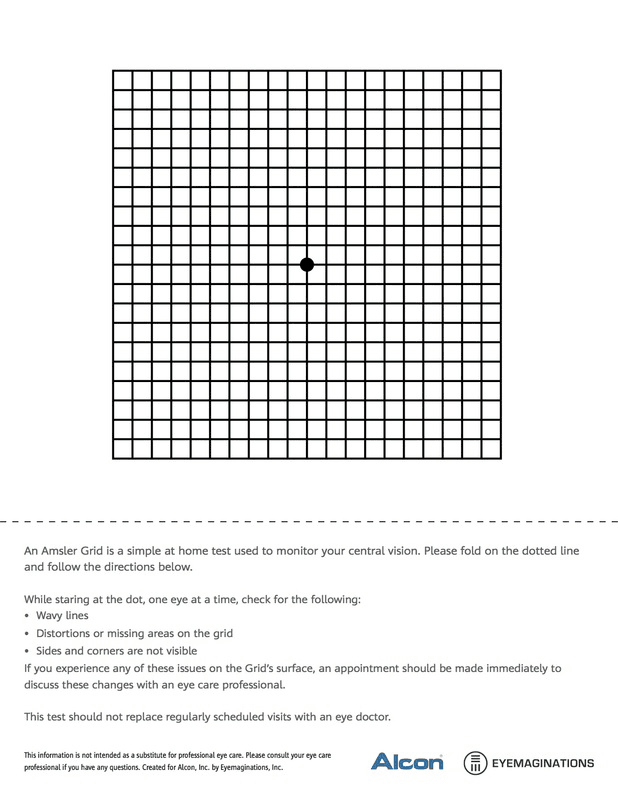
Test each eye separately at a consistent reading distance. Contact the treating service for a new or meaningful change rather than relying on repeated self-testing.
Printing matters
Use the print command instead of a screenshot so the grid remains square. Printer scaling can vary; the important part is using the same setup each time and following the clinician's instructions.