Monitoring and risk reduction
Regular review, smoking cessation, cardiovascular risk care and a balanced diet are commonly discussed. Follow-up frequency depends on stage.
Shifa International Hospital, Islamabad
Medical retina
AMD affects central vision. Distinguishing dry from wet disease guides monitoring, supplements in selected patients and injection treatment where indicated.
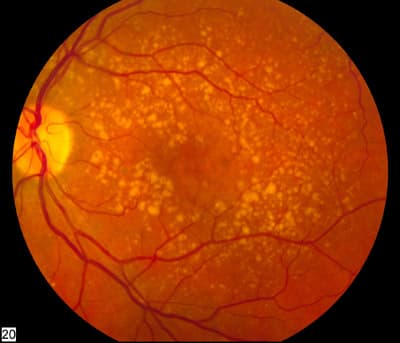
If straight lines suddenly appear wavy, a new central blur or dark patch develops, or vision changes quickly, contact an eye-care service without delay.
Understanding the concern
Age-related macular degeneration affects the macula, the part of the retina responsible for detailed straight-ahead vision. It does not usually remove all peripheral vision, but it can make reading, recognising faces and close work difficult.
Dry AMD is more common and often progresses slowly. Wet AMD involves abnormal leaking blood vessels and can cause faster change. New distortion or a central dark patch needs timely assessment.
What patients notice
These features can overlap with other eye conditions. Examination is needed to establish the cause.
Specialist assessment
Examination determines the type and stage of AMD and whether active leakage or another macular condition is present.
The retina is checked for drusen, pigment change, fluid, blood and scarring.
OCT can detect retinal fluid and structural change and is commonly used to monitor treatment response.
Angiography or OCT angiography may be advised when the pattern of abnormal vessels or leakage needs clarification.
Treatment planning
The plan depends on stage and type. Vitamins are not appropriate for every patient, and injections are used for active neovascular or wet disease rather than routine dry AMD.
Regular review, smoking cessation, cardiovascular risk care and a balanced diet are commonly discussed. Follow-up frequency depends on stage.
Specific supplements may be recommended for particular stages of AMD after examination. They are not a cure and should be discussed with the treating clinician.
Wet AMD is commonly treated with repeated intravitreal anti-VEGF injections and OCT monitoring.
When central vision remains limited, magnification, lighting strategies and rehabilitation can help preserve independence.
Macular care
At a glance
Prof. Amer Awan's medical-retina work includes age-related macular degeneration and intravitreal treatment. Examination and imaging determine whether monitoring, supportive measures or injection treatment is appropriate.
Questions patients ask
AMD primarily affects central vision and does not usually remove all peripheral vision. It can still have a major effect on reading and detailed tasks.
No. Evidence-based formulations are recommended for selected AMD stages, not for every person. Ask after a retinal examination.
Intervals vary by medicine, disease activity and response. Many patients require an initial course and ongoing monitoring, with the schedule adjusted over time.
No. It can help notice change between visits but does not diagnose AMD or replace OCT and dilated examination.
Continue reading
General information sources: Prof. Amer Awan - current public profile; National Eye Institute - Age-related macular degeneration.